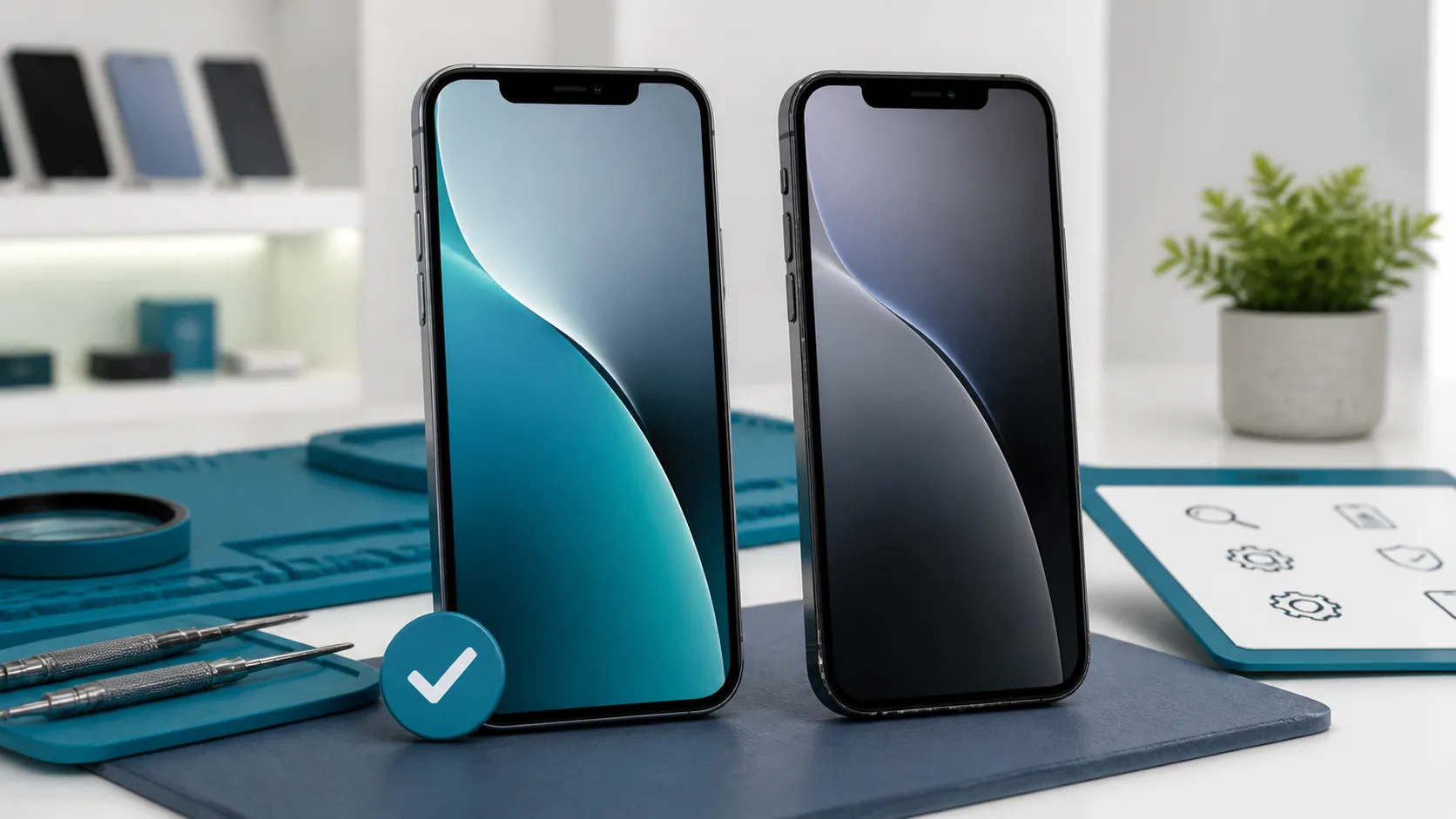
If you are searching for a refurbished iPhone in Sri Lanka, you will probably also see phones described as used, pre-owned, renewed, Grade A or like new. These labels can make two similar-looking iPhones appear very different in value, even when their real condition is almost the same.
The important difference is not the label printed on the advertisement. It is what happened to the phone before it was offered for sale, what the seller can prove about its condition and what protection you receive after paying.
Our short recommendation: choose a refurbished iPhone when the seller provides documented testing, clear repair information and a meaningful written warranty. Choose a used iPhone when you can inspect it properly and its lower price fairly compensates for the additional risk.
Refurbished vs Used iPhone: The Quick Answer
A refurbished iPhone is a previously owned or returned phone that has supposedly been inspected, tested and prepared for resale. Faulty parts may have been repaired or replaced. It may also be cleaned, reset and cosmetically graded before being sold with a warranty.
A used iPhone is normally sold in its current condition. It may have been tested by the seller, but it has not necessarily gone through a formal refurbishment process. Private sellers commonly sell used phones as-is, while established shops may inspect them and provide a limited warranty.
This means all refurbished iPhones are pre-owned, but not all used iPhones have been refurbished.
A properly refurbished phone is usually the lower-risk choice. However, a well-maintained used iPhone with an honest history can be better than a poorly repaired phone carrying a vague “refurbished” label.
The Main Differences at a Glance
The word “should” matters in this comparison. There is no single refurbishment process followed by every independent seller. A higher price is justified only when the seller provides something measurable in return, such as better testing, documented repairs, a stronger battery, an enforceable return option or useful warranty coverage.

What “Refurbished” Really Means
Apple Certified Refurbished
Apple’s own programme is a useful quality benchmark. The Apple Certified Refurbished process includes full functional testing, cleaning and inspection. Apple says refurbished iOS devices receive a new battery and outer shell, genuine replacement parts where required and a one-year limited warranty.
Those benefits apply to Apple Certified Refurbished products. They should not be assumed for every phone advertised as refurbished by another seller.
Imported Apple-certified devices can also create a practical warranty question. Apple’s warranty terms state that iPhone service may be restricted to the country where Apple or an authorised distributor originally sold the device. Before importing or buying imported stock, confirm who will handle a claim in Sri Lanka.
Seller-refurbished iPhones
An independent refurbisher may perform excellent work, but the process is seller-specific. One shop might run detailed diagnostics, replace defective parts and provide a proper warranty. Another might only reset, clean and grade the same phone.
Ask these questions before accepting a refurbished premium:
- What inspection was completed?
- Was the phone repaired?
- Which parts were replaced?
- Were the replacement parts genuine Apple, previously used Apple parts or third-party parts?
- Was the battery replaced or only tested?
- What minimum battery health does the seller accept?
- Can I see a written inspection report?
- What faults are excluded from the warranty?
If the seller cannot answer clearly, treat the device as an ordinary used phone when deciding what it is worth.
Used and Grade A iPhones
A used phone is not automatically unreliable. Some owners protect their devices carefully, avoid major repairs and sell them with good battery health. Such a phone may be a better purchase than one that has undergone several low-quality repairs.
Terms such as Grade A, excellent or like new normally describe cosmetic appearance. They do not prove that the battery, display, cameras or internal components are original. A shiny outer surface should never replace a technical inspection.
Which Option Should You Buy in Sri Lanka?
Choose refurbished when you want lower risk
A refurbished iPhone is generally the better fit for a first-time buyer, someone purchasing remotely or anyone who values after-sales protection. It is worth paying more when you receive:
- A documented multi-point inspection.
- Clear battery-health information.
- Disclosure of replaced parts.
- A reasonable testing or return period.
- A written warranty from a seller with an accessible service location.
- An invoice identifying the device by IMEI.
Do not pay extra merely because the advertisement says “refurbished.” Pay extra for the reduced risk that a genuine refurbishment process provides.
Choose used when value matters most
A used iPhone may be the better-value option when you can inspect it in person, verify its history and get a meaningful discount. It can suit experienced iPhone users who understand battery wear and can recognise common hardware problems.
Use part of the saving as a safety margin for a future battery replacement or minor repair. If the used phone is only slightly cheaper than a properly tested device with a useful warranty, the saving may not justify the extra risk.
Avoid the purchase when important information is missing
Walk away if the phone is Activation Locked, the seller refuses testing, the IMEI cannot be verified or the warranty exists only as a verbal promise. You should also be cautious when the battery-health screen is unavailable, Parts and Service History shows an unexplained warning or Face ID does not work.
The seller’s willingness to disclose problems is often more valuable than a perfect cosmetic grade.
Checks to Complete Before Paying
Check ownership, parts and battery information
Turn on the phone and confirm that it is not showing “iPhone Locked to Owner.” Apple’s pre-owned iPhone inspection guidance says not to buy an iPhone with Activation Lock enabled.
Open Settings → General → About. On supported models running iOS 15.2 or later, Parts and Service History may show information about replaced components. Depending on the phone and repair, you may see labels such as Genuine, Used, Unknown or Unverified.
An Unknown message does not tell you everything that happened to the phone, but it needs an explanation. It can appear when a part is non-genuine, modified, not properly verified or not functioning as expected. Parts and Service History also varies by iPhone model, so the absence of a section does not prove that every component is original.
Next, open Settings → Battery → Battery Health & Charging. Look at maximum capacity, Peak Performance Capability and any important battery message.
As a practical buying guide, battery health above 90% provides more comfort, while a phone in the mid-to-high 80s may still be worthwhile at the right price. If it is approaching 80%, plan for a battery replacement sooner. These are buying guidelines, not guarantees: battery quality, usage history and the authenticity of the battery also matter.
Test the important functions
- Set up and unlock Face ID or Touch ID.
- Test every rear camera, the front camera, autofocus, flash and video recording.
- Record and replay your voice using Voice Memos.
- Play audio through the speakers.
- Test the volume buttons, side button and Ring/Silent switch or Action button.
- Connect to Wi-Fi and Bluetooth.
- Insert a working SIM or activate the supported eSIM arrangement.
- Make a call and test mobile data.
- Connect a charger and check that the port is stable.
- Inspect the display, frame, camera lenses and charging port under good light.
Under Settings → General → About, check Network Provider Lock. “No SIM restrictions” means the phone is not locked to a specific network provider.
Check the IMEI, model and warranty
Dial *#06# or find the IMEI under Settings. The Telecommunications Regulatory Commission of Sri Lanka instructs buyers to check an IMEI by sending IMEI [space] the 15-digit IMEI number to 1909. Complete this check before payment.
Confirm that the same IMEI appears on the invoice. If the phone supports two IMEIs, ask the seller to identify both. Also verify the exact regional model because imported variants can have different physical-SIM and eSIM arrangements.
Finally, read the warranty instead of asking only how many months it lasts. Confirm:
- Whether the battery, display, Face ID, cameras and charging system are covered.
- Whether the remedy is a repair, replacement or store credit.
- Which problems are treated as accidental or liquid damage.
- Whether there is a separate testing or return period.
- Who pays transport if you live outside the seller’s area.
- Where the phone must be taken for a claim.
A short, clearly written warranty can be more useful than a long warranty filled with exclusions.
Frequently Asked Questions
Does every refurbished iPhone have a new battery?
No. Apple says its own certified refurbished iOS devices receive a new battery, but an independent refurbisher may only test the existing battery. Ask the seller whether the battery was replaced, what type of replacement was used and whether it is covered by the warranty.
Is 100% battery health proof that the phone is reliable?
No. It may indicate a new or lightly used battery, but it does not confirm the quality of the display, cameras, logic board or previous repairs. Check for battery messages, review Parts and Service History and test the complete phone.
Can a used iPhone be better than a refurbished one?
Yes. A carefully maintained used iPhone with original components and a transparent history can be better than a poorly repaired refurbished phone. Judge the individual device, not just its sales category.
How can I tell whether an iPhone has been repaired?
Check Parts and Service History under Settings → General → About on supported models. Ask for repair records and inspect the phone for unexplained warnings or non-working functions. Remember that the feature may not display every historic repair on every model.
What warranty should I ask for in Sri Lanka?
Ask for a written shop warranty that identifies the phone by IMEI and clearly states its duration, covered components, exclusions and claim process. Never rely only on a verbal promise or assume that an imported phone has local Apple warranty service.
Final verdict: a properly refurbished iPhone is normally the safer choice, while a well-inspected used iPhone can offer the best price. The right purchase is the phone with the clearest history, strongest evidence and most useful after-sales protection.
If you are uncertain about a device, bring it to a trusted technician before paying. Buyers in Kandy can also contact Udarata Computers to ask about current used iPhone availability, inspection details and the warranty that applies to a specific phone.